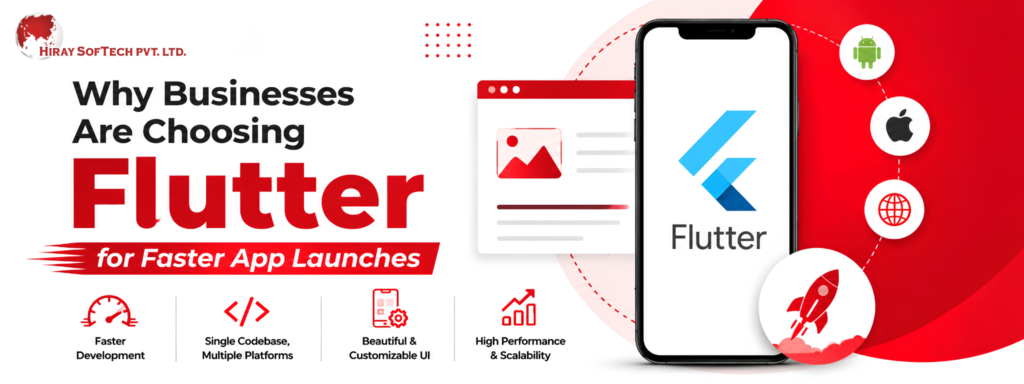

In today's fast-moving digital world, speed matters. Businesses want mobile apps that are not only high-performing but also cost-effective and quick to launch — and that's exactly why more businesses in 2026 are choosing Flutter app development.
Built by Google, Flutter lets developers create apps for both Android and iOS from a single codebase. That means faster development, lower costs, and a quicker route to market — which is precisely what startups, SMEs, and growing businesses need when the priority is launching well without compromising quality.
What is Flutter?
Flutter is Google's open-source, cross-platform framework for building apps that run natively across four surfaces from one codebase:
Android
iOS
Web
Desktop
The core advantage is simple: build one application, deploy it everywhere. Instead of maintaining a separate Android build and a separate iOS build, teams ship both from a single development process — which is where the time and cost savings begin.
TWO PLATFORMS, TWO BUILDS — VS — TWO PLATFORMS, ONE CODEBASE
01
Faster development with one codebase
Traditional native development means separate code for Android, separate code for iOS, and separate testing cycles for each — effectively doubling the work before a single feature ships. Flutter collapses that into one process.
One codebase works for both platforms
Reduced development time
Easier updates across platforms
Faster app launches
Why it matters
Faster development translates directly into a quicker launch, earlier market entry, and faster customer feedback — the three things that compound into a real head start.
02
Cost-effective for startups and growing businesses
Budget is a major factor for most businesses evaluating a new app. Flutter reduces cost at nearly every stage of the build.
One team handles both platforms
Less duplication of work
More efficient testing
Simpler ongoing maintenance
Business benefit
Instead of budgeting separately for Android development, iOS development, and multiple update cycles, businesses fund one efficient process — freeing up runway for everything else.
This makes Flutter especially well suited to:
Startups
Small businesses
MVP launches
Businesses testing a new app idea
03
Faster time to market
In 2026, businesses don't want to spend months building an app before they can test it. They want to launch, validate the idea, gather user feedback, and improve quickly — and Flutter is built to support that pace, with rapid development, faster prototyping, quick UI building, and easier iteration.
Why it matters
A faster launch helps a business beat competitors to market, test new segments sooner, and start generating real user engagement earlier in its runway.
04
Great UI and smooth performance
A common concern is that cross-platform apps compromise design or performance. Flutter addresses this directly with rich UI components, smooth animations, modern interfaces, and near-native performance — letting teams build apps that look professional, feel responsive, and deliver a strong user experience.
Why it matters
A better app experience leads to improved user satisfaction, higher engagement, and stronger retention over time.
05
Easier updates and maintenance
Launching the app is only the beginning — every app needs updates, bug fixes, new features, and performance improvements over time. Because changes are managed in one codebase, Flutter updates ship faster and version consistency across platforms is far easier to maintain.
Business benefit
This reduces long-term development complexity and helps businesses scale their app more efficiently as it grows.
06
Ideal for MVP and startup app launches
For most startups, the goal isn't a perfect app on day one — it's a working MVP (Minimum Viable Product) that can launch quickly. Flutter supports that goal directly: build faster, reduce cost, test core features, and validate the market before committing to a bigger investment.
Especially useful for:
Startup founders
Entrepreneurs
Businesses launching their first app
07
Strong support from Google, and growing adoption
Flutter is backed by Google, which gives businesses confidence in the framework's long-term future. It's also supported by a strong developer community, growing business adoption, regular updates, and wide plugin and integration support.
Why it matters
Businesses want technology that is reliable, scalable, and future-ready — and Flutter continues to grow as a trusted framework for modern app development.
When Flutter is the right choice
Flutter is a strong option if your business wants:
A faster app launch
Lower development cost
Android + iOS together
Strong UI and smooth performance
MVP or startup app development
Easier future updates
Service businesses
Startups
E-commerce apps
Booking apps
Internal business apps
Customer engagement apps
In 2026, businesses are choosing Flutter because it offers the balance of speed, cost-efficiency, cross-platform reach, modern UI, and a faster market launch — without the higher cost and longer timelines of native development.
One codebase
Android + iOS together
Lower cost
One team, one process
Faster launch
Rapid prototyping, quick iteration
Built to scale
Backed by Google