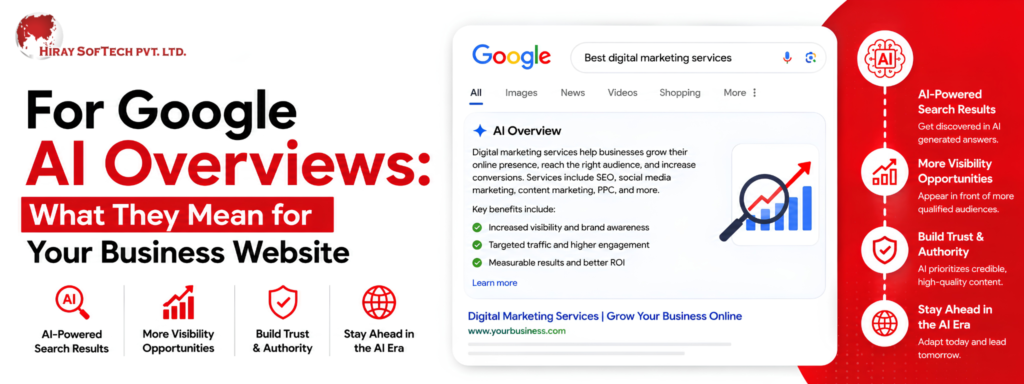
Search is changing fast, and one of the biggest shifts in 2026 is the rise of Google AI Overviews. Instead of showing only traditional blue links, Google now often displays an AI-generated summary at the top of results — pulled from multiple sources, answering the query before anyone has to click through.
For any business that depends on organic traffic, that changes how visibility works. If your website is going to stay visible, trusted, and competitive, your SEO strategy needs to adapt to it.
What are Google AI Overviews?
AI Overviews are AI-generated summaries shown in search results for certain queries. They typically appear above standard organic listings, before many users ever click a website, as a direct answer to informational or problem-solving searches. For example:
Q What is local SEO?
Q How does digital marketing help small businesses?
Q SEO vs AEO in 2026
For queries like these, Google may show a summarized answer before the regular results — which means one important thing: your business is no longer competing only for rankings. You're also competing to be part of the answer.
AI OVERVIEW + CITATIONS, SITTING ABOVE THE TRADITIONAL RESULT LIST
Zero-click search
In some cases, users get their answer directly from Google without clicking any website. That can look like a loss of traffic — but if your content is strong, helpful, and well structured, Google may use it as part of the summary itself. Even without a click, your brand becomes more visible, more trusted, and more recognizable.
How AI Overviews can impact your website
01
Fewer clicks on some informational searches
Basic informational blogs may see lower click-through rates when Google answers the query directly.
02
Higher importance of authority and trust
Google is more likely to draw on websites that demonstrate real expertise and clear structure.
03
Greater value for branded and high-intent content
If users trust your brand from an AI summary, they may search for your business directly later.
04
More weight on content quality
Thin or generic content is far less likely to be surfaced in AI-generated results.
In short
Ranking alone is no longer enough. Content also has to be trustworthy, well structured, and genuinely useful enough to be summarized.
How to optimize for Google AI Overviews
Six practical levers that improve the odds your content gets pulled into the summary — not just ranked below it.
01
Write answer-focused content
Directly answer common questions using short paragraphs, clear definitions, and simple explanations.
02
Use strong headings and subheadings
Well-structured content is easier for AI systems to read, parse, and summarize accurately.
03
Add FAQ sections
FAQ content increases the chances of being pulled into answer-based search results.
04
Build topical authority
Publish multiple related blogs around one subject — SEO in 2026, AEO vs SEO, technical SEO, local SEO — to signal a trusted source.
05
Strengthen E-E-A-T
Show real Experience, Expertise, Authoritativeness, and Trustworthiness with genuine insight, examples, and accurate detail.
06
Keep technical SEO strong
Fast loading, mobile responsiveness, clean structure, schema markup, and strong internal linking still matter.
What type of content works best
In the age of AI Overviews, the best-performing content tends to share the same shape — useful, structured, and built around real user intent:
How-to guides
Comparison blogs
FAQs
Service explanation pages
Local SEO pages
Definition-based content
Problem-solving articles
What businesses should do in 2026
Keep publishing helpful, original content
Build topic clusters, not random blogs
Focus on both SEO and AEO
Optimize for featured snippets and AI summaries
Strengthen brand credibility
Improve local SEO for service-based searches
Google AI Overviews are not the end of SEO — it's evolving. In 2026, the winning strategy blends traditional SEO for rankings, AEO for answer-based visibility, and strong branding for trust.
SEO
Rankings and traffic
AEO
Answer-based visibility
Branding
Trust and recognition
Answer-worthy
Not just searchable