Running digital ads and marketing campaigns is easy today.
But the real challenge for small businesses is this:
✅ “Are we actually making money from it?”
Not just getting likes, clicks, or followers — but real leads, real customers, and real sales.
That’s where ROI (Return on Investment) comes in.
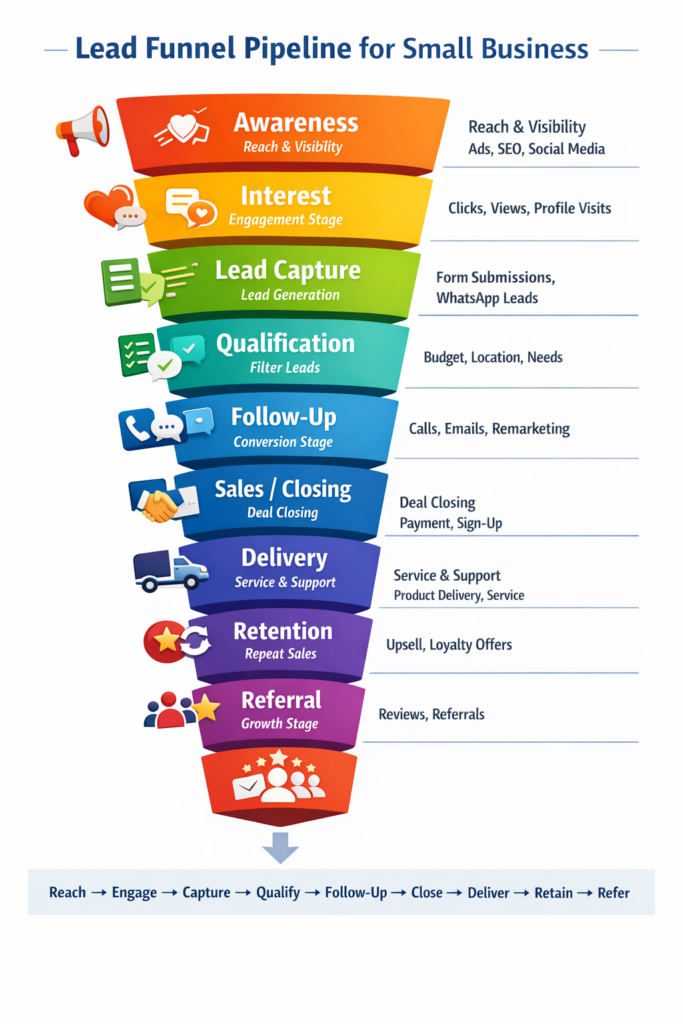
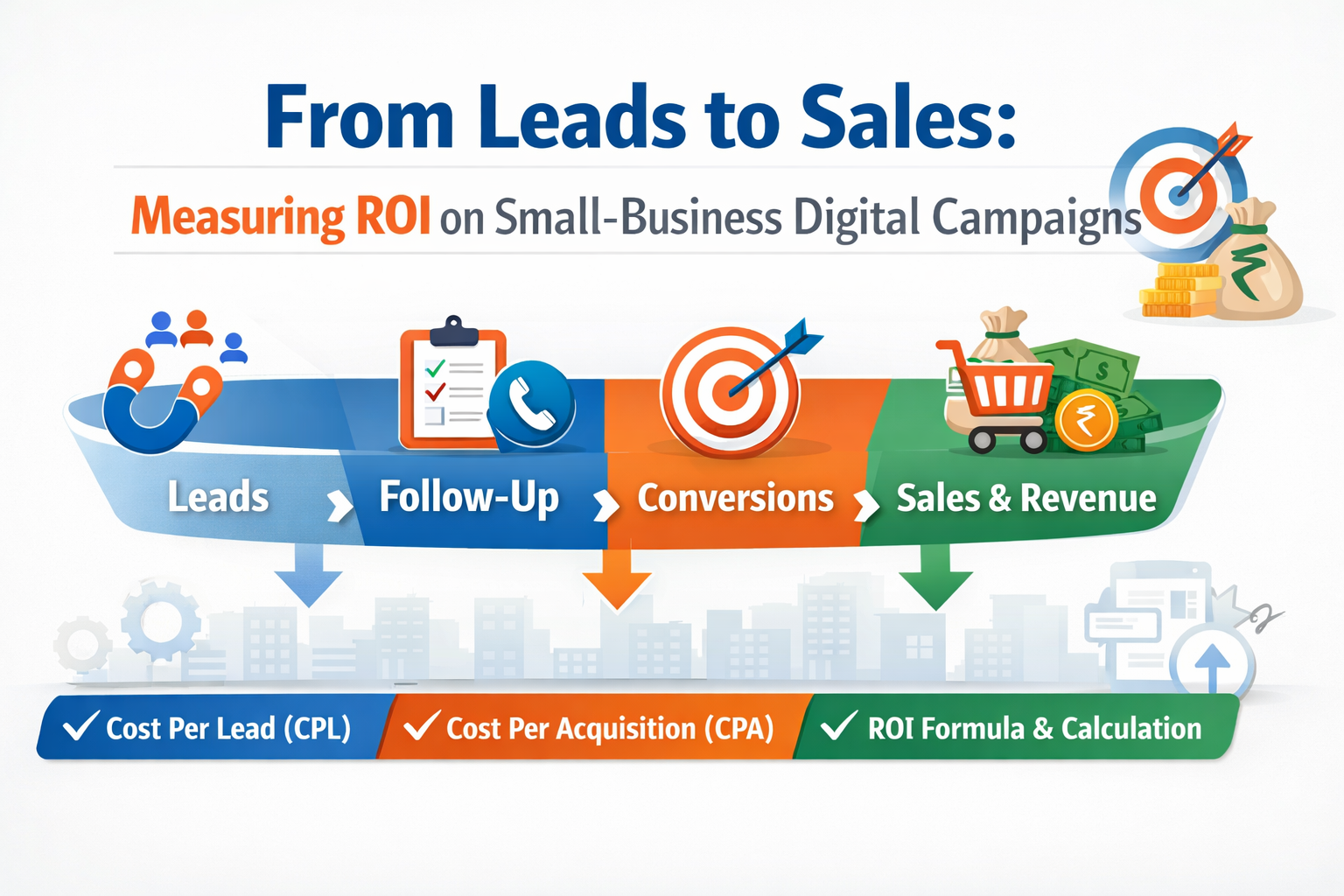
In this blog, we’ll break down how small businesses can measure ROI from digital campaigns — in a simple, practical way — and how to move from leads → conversions → sales.
Many small businesses feel happy when:
But if these numbers are not generating sales, then marketing becomes an expense — not an investment.
ROI tells you whether your marketing is:
✅ Profitable
✅ Scalable
✅ Worth continuing
❌ Or needs improvement
ROI is a simple formula:
ROI = (Revenue – Cost) ÷ Cost × 100
Example:
If you spend ₹10,000 on a campaign and earn ₹50,000 from it:
ROI = (50,000 – 10,000) ÷ 10,000 × 100
ROI = 400%
That means your marketing returned 4x profit.
Vanity Metrics (Not enough)
Small businesses often run ads but don’t track where leads come from.
Your leads can come from:
Use UTM links and a proper CRM sheet to track every lead.
CPL = Total Ad Spend ÷ Total Leads
Example:
Spend ₹5,000 and get 50 leads:
CPL = ₹5,000 ÷ 50
CPL = ₹100 per lead
Now the next question becomes:
Are these leads converting into customers?
Not all leads are equal.
You may get 100 leads but:
So you must track lead quality.
Lead quality indicators:
This is the most important number.
Conversion Rate = (Total Customers ÷ Total Leads) × 100
Example:
50 leads → 5 customers
Conversion Rate = (5 ÷ 50) × 100
Conversion Rate = 10%
CPA = Total Spend ÷ Total Customers
Example:
Spend ₹10,000 and get 10 customers:
CPA = ₹10,000 ÷ 10
CPA = ₹1,000 per customer
Now you can decide:
✅ Is ₹1,000 worth it to acquire 1 customer?
If your average profit per customer is ₹5,000, then yes — it’s a great campaign.
To measure ROI, you need revenue.
Here’s how to do it for small businesses:
Track exact sales per customer.
Track:
Example:
10 customers × ₹8,000 average order = ₹80,000 revenue
Now apply ROI formula:
ROI = (Revenue – Cost) ÷ Cost × 100
Example:
Revenue = ₹80,000
Cost = ₹10,000
ROI = (80,000 – 10,000) ÷ 10,000 × 100
ROI = 700%
🔥 That’s an excellent campaign.
Most Small Businesses Lose ROI Because of These Mistakes
Here are the most common issues:
❌ 1. No follow-up system
Leads come in but nobody calls fast.
❌ 2. Slow response time
If you respond after 2–3 hours, the lead is already gone.
❌ 3. No lead tracking sheet / CRM
You don’t know:
❌ 4. Wrong targeting
Your ads are shown to the wrong audience.
❌ 5. Poor landing page or WhatsApp flow
Leads drop because the process is confusing.
Here’s a simple ROI-boosting checklist:
✅ Track every lead source
✅ Respond within 5–10 minutes
✅ Use WhatsApp automation + quick replies
✅ Use remarketing ads
✅ Run campaigns with clear CTA (Call / WhatsApp / Book)
✅ Use conversion tracking (Meta Pixel + Google Tag)
✅ Weekly report: Leads, Sales, ROI
You don’t need expensive software. Start with:
Digital marketing is not about getting more clicks.
It’s about:
When you measure ROI properly, your business stops guessing and starts growing.
If you’re running ads but not seeing sales, you don’t need more ads.
You need:
✅ better tracking
✅ better follow-up system
✅ better targeting
✅ better conversion strategy
Copyright © 2015. All rights reserved.